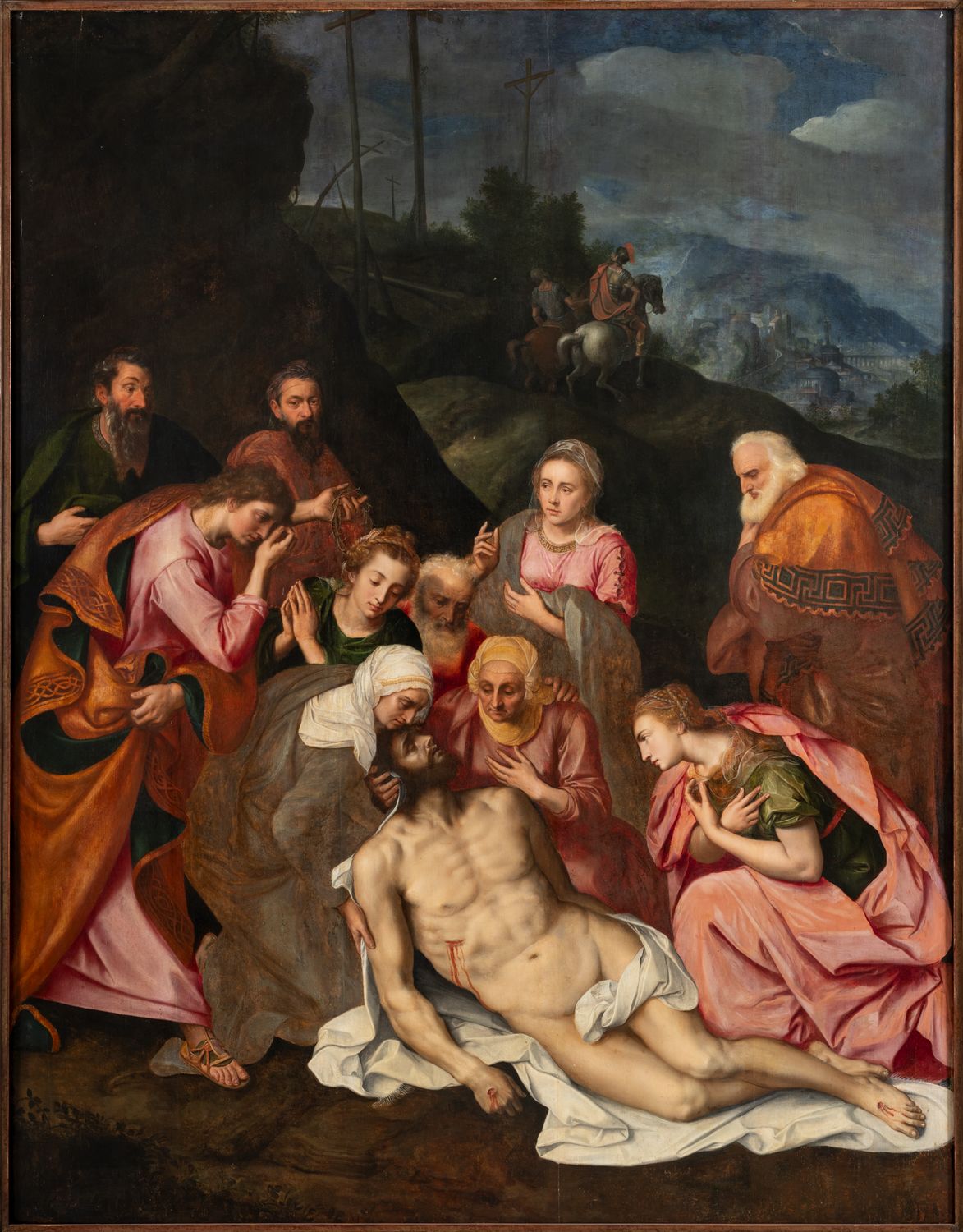
Lamentation of Christ with Donors

In the Lamentation of Christ with Donors, dating from 1553, painter Willem Key combined artistic innovation with intimate devotion. This impressive masterpiece, acquired by the Charles Vreeken Fund, takes us right back to 16th century Antwerp and enables us to rediscover Willem Key, a forgotten master of the Flemish Renaissance. It is without doubt a major work and it will be shown in preview at the King Baudouin Foundation’s stand at the 2026 BRAFA, prior to being exhibited at M Leuven.

A rarity to be preserved

The acquisition of this work by the Charles Vreeken Fund is of great significance. Willem Key was born in Breda c. 1515 and died in Antwerp in 1568, but few of his great paintings have survived and none are on permanent show in a Flemish museum. In becoming part of the collection of M Leuven, this masterpiece, which was uniquely signed and catalogued by Key, is filling an important gap, as well as providing the public with an opportunity to see a key 16th century work. The paint-ing has also been recognised as a rare and exceptional masterpiece by the Flemish Government.

Willem Key, master of the Flemish Renaissance

Although less well known to the general public today, in his time Willem Key was one of the leading figures of the Flemish Renaissance, a status still recognized by specialists today. He studied under Pieter Coecke and Lambert Lombard and he combined Flemish tradition and Italian audacity in his painting. His style is characterised by subtle realism, emotional restraint and great attention to the textures of his paintings. In addition to being a famous portraitist, he was also a remarkable painter of history and was both recognised and admired by his peers. Key created portraits of powerful figures of his time, such as the Duke of Alba. However, part of his oeuvre was destroyed during the wave of iconoclasm known as the Beeldenstorm, which swept across the Low Countries in 1566.

A sacred scene, with many portraits

The Lamentation of Christ with Donors is a monumental panel, dated 1553. It represents the body of Christ, surrounded by the Virgin Mary, Saint John and the Holy Women, as well as two donors, who are identifiable thanks to the inscriptions on their clothes. The painting masterfully mixes emotion, which is characteristic of Flemish masters such as Quinten Metsijs, with the power of Italian models, such as those by Michelangelo. Considered as the original work, this composition inspired numerous copies to be made, both within Key’s own studio and elsewhere, thereby contributing to the model being disseminated across Europe. Thanks to its monumental scale, the quality of execution and its originality, this painting on panel illustrates the pinnacle of Antwerp art pre-Rubens.

A BRAFA première

The general public will be able to discover this work for the very first time at the BRAFA, Heysel, from January 25th to February 1st, 2026. At certain times during the day, a conservator will be present to explain in detail the restoration being undertaken. The discolouration of some of the blues, notably the smalt blue, a phenomenon that is typical for a work of this age, will be corrected in order to restore the painting’s original brilliance. After being exhibited at the BRAFA, restoration of the painting will be continued prior to its being transferred to M Leuven, where it will go on show in 2026 (08.10.26–28.02.27), as part of an exhibition devoted to Flemish sculptors in Italy.

The Charles Vreeken Fund

The Charles Vreeken Fund, managed by the King Baudouin Foundation, focuses on the acquisition, conservation and promotion of works by Belgian artists, from all periods and artistic disciplines. Its primary aim is to support museums in Belgium through facilitating the development of their collections and supporting projects that help them be more widely known.

Material / technique: 
Oil on panel
Dimensions: 
171,5 x 131,5 cm
Type of acquisition: 
Acquired by the Charles Vreeken Fund
Year of acquisition: 
2025
Depository institution: 
M Leuven