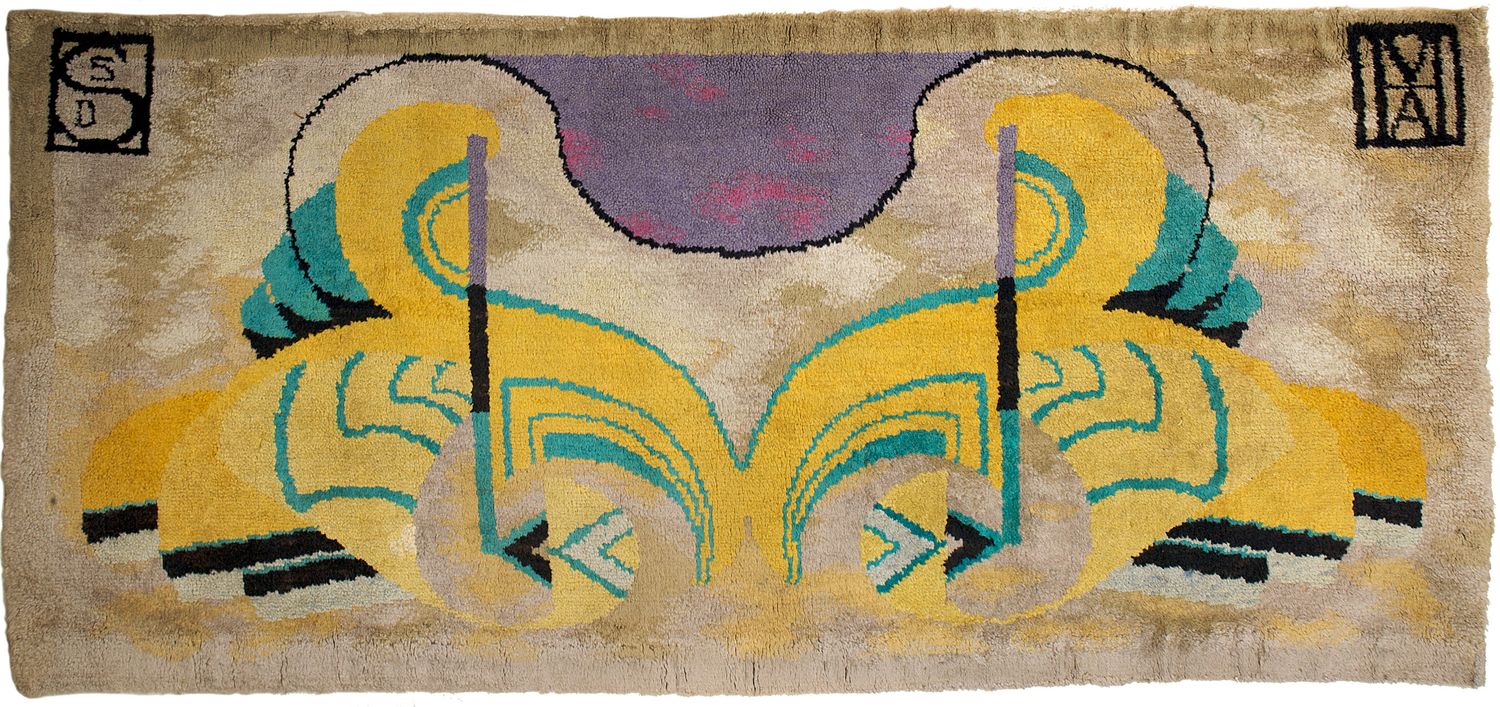
Art Deco style rug

Elisabeth De Saedeleer
1924

The Raphaël and Françoise Haeven Fund, managed by the King Baudouin Foundation, has enabled the acquisition of an emblematic rug created by the Belgian textile artist Elisabeth De Saedeleer, which will be shown at BRAFA. Afterwards it will be presented at the Design Museum Brussels.

Belgian heritage with a female slant

The acquisition of this rug by Elisabeth De Saedeleer (1902-1977) is part of an ambitious approach in the promotion of Belgian heritage, and more particularly of work by female artists and designers, who have, for far too long, remained in the shade of art history.

A textile masterpiece from the interwar period

The great appeal of this rug lies in the quality of its execution, the harmony of lines and the vivacity of its colours, which are visible again thanks to recent restoration. This is a rare work by Elisabeth De Saedeleer and is emblematic of Belgian creativity in the period between the two world wars, but which is rarely present in public collections today.

De Saedeleer & Van huffel: a unique artistic alliance

Created by Elisabeth De Saedeleer, a key but often overlooked figure in the revival of tapestry making in Belgium, this piece embodies the spirit of the English Arts & Craft movement with its emphasis on demanding artisanal know-how (the rug is hand-knotted), together with a sophisticated modernist design. It also bears witness to the wealth of artistic collaboration during this period since it was created in close cooperation with the architect Albert Van huffel, known particularly for his design of the Koekelberg Basilica in Brussels and a leading figure of the Art Deco movement in Belgium. This association confers an artistic, historical and symbolic significance on the work. The monograms of the two artists can be seen in the upper two corners of the rug.

Art in heritage

Textile artist Elisabeth De Saedeleer was one of the first female lecturers recruited by Henry van de Velde for the Institut Supérieur des Arts Décoratifs de La Cambre, alongside the bookbinder Berthe van Regemorter. With the appointment of Elisabeth De Saedeleer as Director of the Textile Art Studio in 1927, Van de Velde was calling upon a well-known artist. De Saedeleer had been introduced to weaving thanks to the influence of May Morris (wife of William Morris) while her family was living in England during World War I. In 1921, her father, Valerius De Saedeleer, set up a weaving workshop in Etikhove, where Elisabeth founded a weaving section with her sisters. In 1925, when the workshop was re-baptised Studio De Saedeleer, she became its director, together with the artist Paul Haesaerts. The studio met with great success, working with well-known artists. During World War II, the German authorities prevented Elisabeth De Saedeleer from continuing to teach at La Cambre, because of the Jewish origins of her husband Léon Lévy. After the war, she opened her own school, ‘l’École de tissage et de peinture Elisabeth de Saedeleer’ in Uccle (Brussels).

Renewed visibility for a pioneering artist

This work fills an important gap in our public collections. It is now exhibited as part of the permanent exhibits of the Design Museum, in the Belgian design section (belgisch design belge), enhancing the visibility of Elisabeth De Saedeleer and her studio-school, which was at the crossroads of creation, teaching and entrepreneurship.

The Raphaël and Françoise Haeven Fund

This emblematic rug by the Belgian textile artist Elisabeth De Saedeleer was acquired by the Raphaël and Françoise Haeven Fund. The Fund, which is managed by the King Baudouin Foundation, is dedicated to the conservation, restoration and promotion of historical Belgian heritage.

Material / technique: 
Wool and cellulose
Dimensions: 
104 x 219 cm
Type of acquisition: 
Acquired by the Raphaël and Françoise Haeven Fund
Year of acquisition: 
2025
Depository institution: 
Design Museum Brussels