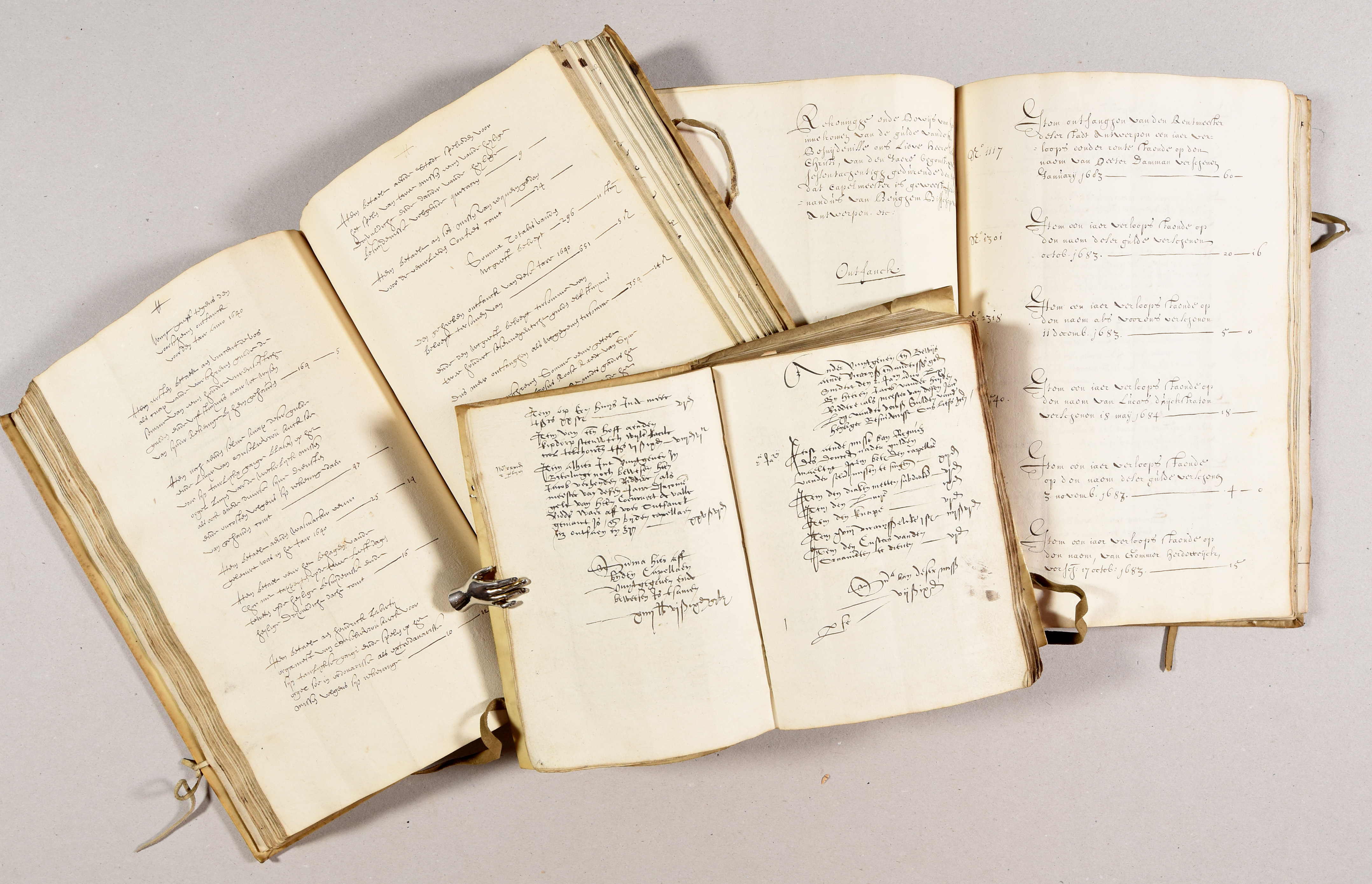
Purchase and reassignment of an outstanding piece of Antwerp heritage
In March 2026, these outstanding manuscripts were acquired by the King Baudouin Foundation through the Raphaël and Françoise Haeven Fund, at the Arenberg Auctions house in Brussels. The purchase was made at the request of the Belgian National Archives as well as a number of Antwerp archival institutions. Thanks to the acquisition, these unique documents, which had been in private hands for over two centuries, have now been returned to Antwerp for permanent keeping to the National Archives.
A rare and significant collection of documents
The collection includes a remarkable 1684 calligraphed copy of the original register of names of the Antwerp Brotherhood of the Holy Circumcision (founded in 1426) and kept up to date until 1786, as well as three volumes of accounts from the period 1559–1720. Such documents are incredibly rare: the Brotherhood’s archive has almost completely disappeared, with only a few comparable 16th century registers remaining in public collections.
This acquisition therefore fills an important gap in existing archives, as well as strengthening the coherence of other preserved registers of the Brotherhood. These invaluable additions will contribute not only to a more complete understanding of the Brotherhood itself, but also of the spirit of the time and religious and social life in Antwerp. Their value to researchers is thus significant.
A window onto social and religious life
The Brotherhood of the Holy Circumcision, founded in 1426, had its own chapel in the Antwerp Cathedral of Our Lady and venerated a relic known as the Holy Prepuce, a fragment of Jesus’s foreskin, that had been brought back to Antwerp during the Crusades by a travelling companion of Godfried van Bouillon. The relic disappeared in 1566 during the Beeldenstorm (Iconoclastic Fury) that struck the cathedral, but the Brotherhood remained. New names were added to the Brotherhood’s register until at least 1786. In 1900, the Catholic Church announced that further veneration of the Holy Prepuce was forbidden.
The Brotherhood brought together prominent citizens of Antwerp. The membership list and accounts provide a unique insight into the role of lay people in the religious life of the Netherlands at the beginning of the modern period. The names of important people such as Nicolaas Rockox, the Mayor of Antwerp, illustrate the breadth and prestige of the Brotherhood.
The Brotherhood’s accounts not only document its internal workings, but also provide information about contemporary social practices: the remuneration of musicians, the maintenance of the chapel and the organisation of religious ceremonies. Together, this amazing collection of documents brings to life both the material and immaterial life of the Brotherhoods.
Preservation, access and promotion
The calligraphic copy of the members’ register is visually remarkable. The manuscript, which was executed on parchment and bound in red velvet, is in particularly refined calligraphy and has a richly decorated flyleaf representing the Circumcision of Christ, in a cartouche surrounded by flowers.
The Brotherhood’s membership list and accounts are being integrated into the Cathedral’s archive, which has been kept at the State Archives in Antwerp since 2014. An inventory will be made of all the documents and they will be digitized, making them accessible via existing online platforms. This will ensure that they are safely preserved but also widely accessible to researchers and interested members of the public.