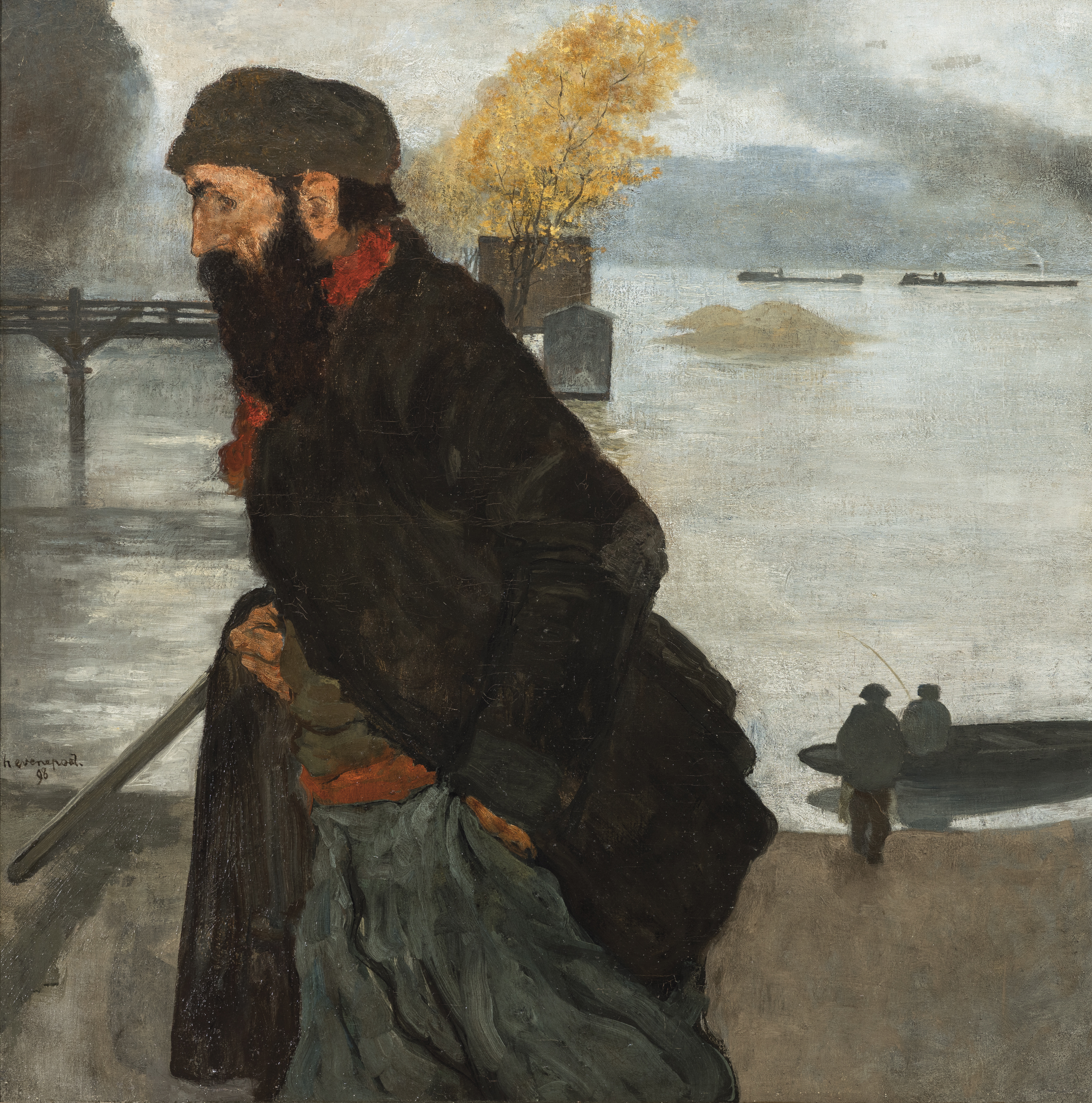
Worker by the Seine

Worker by the Seine is one of Henri Evenepoel’s key works. It offers us a striking representation of working-class life and modernity in Paris at the end of the 19th century. Thanks to its composition and visual intensity, the painting is a significant addition to the collection dedicated to social reality of the period at the Royal Museums of Fine Arts of Belgium. The work joined the public collections thanks to the Isabelle and Philippe Dewez Fund, which acquired it at Galerie De Vuyst.

Henri Evenepoel: a striking take on working-class Paris

Worker by the Seine is essential as a work in understanding Belgian artistic modernity at the end of the 19th century. Its acquisition meets a double objective: strengthening representations of the working class in the museum’s collections and introducing a rare urban scene from Evenepoel’s oeuvre.

An urban scene of great intensity

Worker by the Seine represents a worker on his way to, or from, his place of work, along the banks of the River Seine. With just a few details – the frayed edges of his worn coat, his trousers that are too wide and his hollow, vacant gaze – Evenepoel imbues this working-class figure with remarkable depth as he mechanically follows his daily path in the early hours of the morning. Day is gradually breaking: fishermen head out to sea, the morning greyness lifts from the river and the mist that is mixed with industrial smoke allows the first hesitant rays of sun to filter through. The composition is skilfully constructed. The workman has a monumental position in the painting: not centred, but clearly in movement and moving away from the focal point. Atmospheric greys dominate Evenepoel’s palette, enhanced by the earthy hues of ochre and deep red that structure the scene. The influence of Édouard Manet, as well as that of the Nabis artists, is clear in this emblematic work.

A testament to artistic modernity

Henri Evenepoel (1872 – 1899) was born in Brussels, but moved to Paris in 1892, where he studied under Gustave Moreau and associated with artist such as Henri Matisse. During the seven years prior to his early death in 1899, Evenepoel developed his talent and his sense of syntheticism. His palette of pure colours and his simplification of forms, which would reach their zenith during his Algerian period, are already evident in his Paris works. Worker by the Seine is a particularly accomplished example of this, marrying social observation and formal research.

An essential addition to the collections

The Royal Museums of Fine Arts of Belgium hold a significant ensemble of works that illustrate the social reality of the late 19th century. However, representations of manual workers made by Evenepoel’s contemporaries other than Constantin Meunie remain something of a rarity. Worker by the Seine fills this gap and strengthens the coherence of the collection. Ultimately, the work will be integrated into the Museum’s permanent collection and will certainly play a key role in future exhibitions devoted to modernity, social themes and the works of Evenepoel, in dialogue with works of artists such as Constant Meunier or Henri Matisse.

The Isabelle and Philippe Dewez Fund

Created within the King Baudouin Foundation, the Isabelle and Philippe Dewez Fund supports the acquisition of works for the Royal Museums of Fine Arts of Belgium and the Museum of Ixelles. The Fund’s mission is to promote the accessibility of works of art and to safeguard them for future generations through long-term integration into public collections.

Material / technique: 
Oil on canvas
Dimensions: 
Signature and date lower left: h evenepoel / 98, 82 cm × 81 cm
Type of acquisition: 
Acquired by the Isabelle and Philippe Dewez Fund
Year of acquisition: 
2026
Depository institution: 
Royal Museums of Fine Arts of Belgium, Brussels