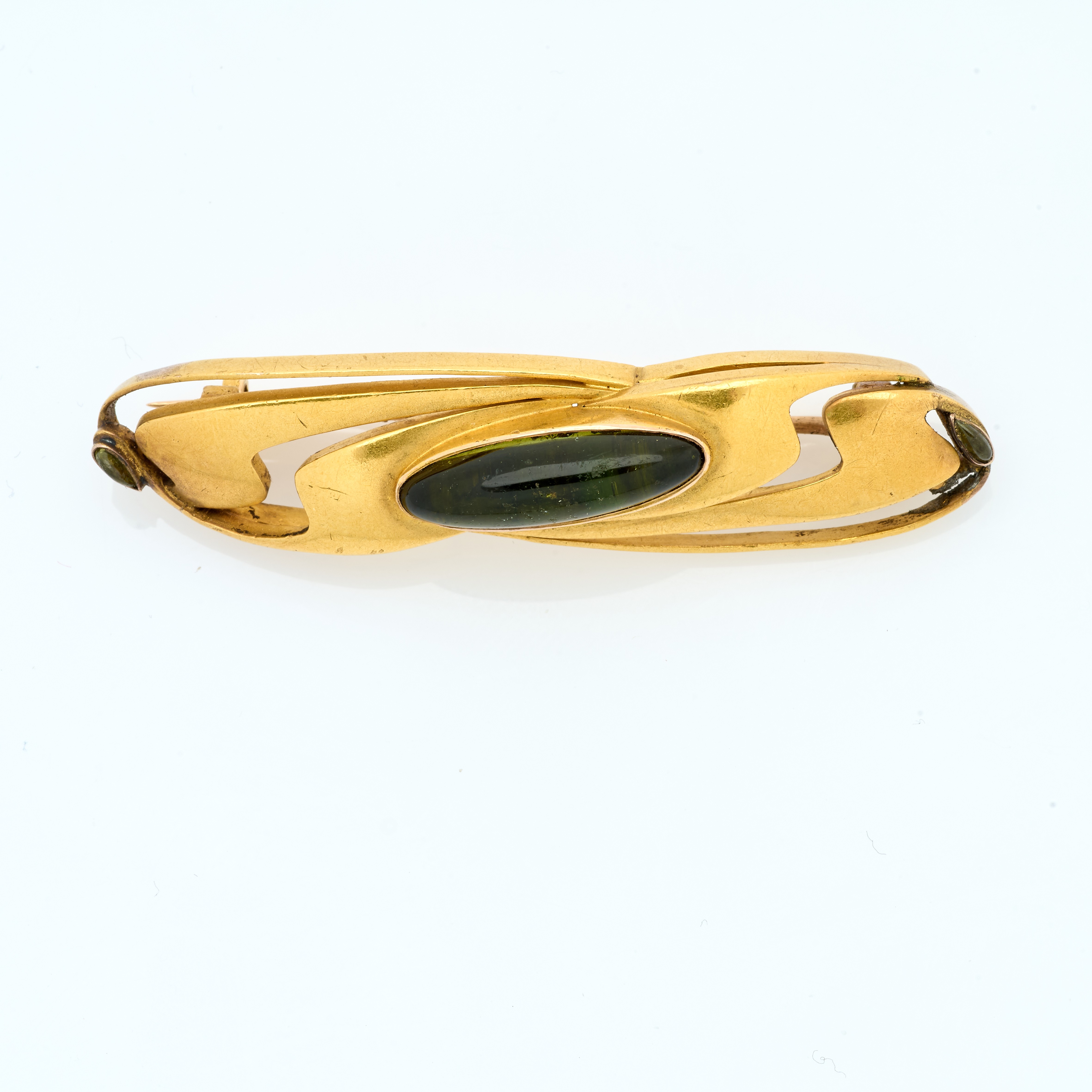
Brooch

Henry van de Velde
1898-1899

This brooch is among the earliest creations by Henry van de Velde and is a rare surviving example of his jewellery design. It reflects a pivotal phase in Van de Velde’s artistic development, during which he moved away from the naturalistic language of Art Nouveau and evolved towards the abstract, dynamic lines that would later form the foundation of modern design. The brooch was aquired through the Marie-Jeanne Dauchy Fund and can be admired at the Art & History Museum in Brussels.

Rare piece of jewellery by Henry van de Velde

Jewellery by Henry van de Velde is exceptionally rare, particularly pieces dating from his first Belgian period before his departure for Berlin in 1900, as this brooch does. The brooch reflects a crucial stage in Van de Velde’s artistic development, marking his break with the naturalistic forms of Art Nouveau and his transition towards an abstract, dynamic visual language that would form the foundation of modern design. It embodies his innovative vision of form, rhythm and functionality, making it a key piece within his oeuvre. The brooch also illustrates his pursuit of harmony between form and idea, his rejection of decorative excess and his search for a universal aesthetic. It encapsulates the essence of Van de Velde’s artistic and theoretical vision: the unity of art and life, form and function. The brooch also marks a turning point in the European decorative arts around 1900. As such, it possesses both outstanding artistic and art-historical significance and represents a valuable addition to the collection of the Art & History Museum, as well as to public art collections in a broader sense.

Henry van de Velde

Henry van de Velde is widely regarded as one of the most influential innovators of the international Art Nouveau movement. His work had a profound and lasting impact on the development of the decorative arts and modern design, in both Germany and Belgium. After a successful artistic career in Belgium, he settled in Germany in 1900. In 1907, he founded the Kunstgewerbeschule Weimar, the applied arts institution that would later evolve into the renowned Bauhaus. In 1927, he established the Higher Institute of Decorative Arts of La Cambre in Brussels, thus also laying the foundations for modern design and arts education in Belgium. Thanks to his pioneering ideas on functionality, purity of form and the aesthetic unity of art and everyday life, he is internationally recognised as one of the founding figures of modern design.

Presentation in the Wolfers Shop

The brooch is on display in the jewellery showcases of the Wolfers Shop at the Art & History Museum in Brussels. This exceptional shop interior, designed around 1910 by Victor Horta for the silversmith and jeweller Wolfers Frères, is a rare surviving ensemble. It underwent a comprehensive restoration in 2017 and was integrated into a room at the museum in a manner that respects its historical context. The Wolfers Shop displays a representative selection of Belgian Art Nouveau jewellery, including masterpieces by Philippe Wolfers, Gustave Serrurier-Bovy, Georges Morren and Henry van de Velde. Many of these works are on long-term loan from the King Baudouin Foundation.

Material / technique: 
Gold, green stone
Dimensions: 
53x12 mm (7.9 g)
Type of acquisition: 
Acquisition of the the Marie-Jeanne Dauchy Fund
Year of acquisition: 
2025
Depository institution: 
Art & History Museum, Brussels