


An exceptional acquisition for the Rubenshuis
In March 2026, at the TEFAF art fair in Maastricht and at the request of the Rubenshuis in Antwerp, the King Baudouin Foundation acquired a particularly rare work by Peter Paul Rubens (1577-1640): an autograph drawing, accompanied by a handwritten letter from the artist, dated 1607.
Drawings and handwritten letters by Rubens appear very rarely on the art market today, so the fact that two appear on a single sheet of paper makes this work even more exceptional. By returning this precious heritage to Belgium and entrusting it to the former home of Rubens, the Foundation is filling a gap in our public collections.
Historical importance and great heritage value
This document offers us a rare view of Rubens’s creative process and diplomatic practice, as well as uniquely documenting the artist’s multifaceted role in the Europe of his time.
In September 1607, Rubens initially used this sheet of paper to draft a letter, written in Italian. Shortly afterwards, in a burst of creativity, it seems that he used the reverse side to sketch a quick and spontaneous drawing, unrelated directly to the contents of the letter.
The letter is one of the rare examples of Rubens’s Roman period and as such represents a heritage document of great value. It shows us a young artist, in his twenties, not only developing his artistic talents, but also playing a role within the cultural and diplomatic ecosystem of a European court. The document is also a reminder of the importance of female patrons such as Eleonora de’ Medici in the production, circulation and promotion of art during the 17th century.
The provenance of this work is well documented. Notably, it was part of the collection of German art historian Ludwig Burchard (1886-1960). Considered as one of the 20th century’s most important Rubens specialists, Burchard laid the foundations for the Corpus Rubenianum Ludwig Burchard, a scientific series of catalogues devoted to the artist’s work and published since 1968. His legacy is thus closely linked to the Rubenshuis.
Three figures in classical dress, probably apostles
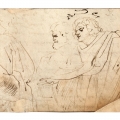
The drawing represents three half-length figures in classical dress, generally considered to be apostles, thanks to their flowing garments and beards. The younger-looking figure on the right, with open arms, can be identified as the apostle John the Evangelist. Clear parallels exist with Rubens’s representations in the series of apostles he painted around 1610–1612. It is not rare to find figures of the apostles whose gaze is turned not upwards, but rather interact gently as part of a horizontal composition, as in themes such as Death of the Virgin, or in scenes from the Acts of the Apostles. During his stay in Italy, Rubens was to become deeply familiar with such representations, particularly in the works of Caravaggio and Raphael, which would become important sources of inspiration to him and his own artistic development.
The drawing’s energetic style and freedom in execution nevertheless preclude it from being simply a copy of an existing painting. It is more probably a freehand study for some future work, executed or not, but not identified. Such studies are extremely rare in the work of Rubens dating from his time in Italy. In this sketch, there is great spontaneity in his depiction of the men, using very few, but precise, strokes; the eyes, for instance, are rendered almost as small blots of ink. Above the figure on the extreme right, we can observe that Rubens has rapidly tested his pen with a quick scribble, probably to check that there was not too much ink on it. The drawing enables us to see, close-up, Rubens’s creative process.
A rare document from the painter’s Italian period
The letter on the reverse side of the sketch also provides us with an important historical and archival document, highlighting the political and cultural networks in which Rubens developed whilst he was in Italy and, more particularly, the key role played by female patrons.
Written quickly, the letter appears to be a draft. It is addressed to a painter commissioned to create a work for someone whom Rubens designates as his ‘serenissima padrona’. This title can almost certainly be associated with Eleonora de’ Medici, wife of Vincento I of Gonzaga and Duchess of Mantua. During his stay in Italy, from 1600 to 1608, Rubens was attached to the House of Gonzaga, where he occupied the post of court painter and worked directly for Eleonora.
Sister of Maria de’ Medici, Eleonora was not only an important figure from one of the most influential dynasties in Europe, but also an active and ambitious patron. After her marriage in 1584, she commissioned numerous paintings and portraits whist also playing a major political role. When her husband the Duke was absent on military campaigns or trips, she acted as regent and governed the duchy. This document testifies to the important role played by aristocratic females in the cultural policy of European courts, where artistic production was closely linked to power, diplomacy and representation.
The recipient of the letter was almost certainly the Roman painter Cristoforo Roncalli, also nicknamed il Pomarancio, who had been commissioned by Eleonora de’ Medici to make a painting for her private chapel. The letter shows that Rubens was involved in following and evaluating such commissions and that court painters were not just executors, but also advisors and intermediaries within their patrons’ system of patronage. In autumn 1607, Rubens was in Rome, where he was leading negotiations relating to works for the Duke and Duchess of Mantua.
Presentation and accessibility
The Rubenshuis will enhance the status of this acquisition by presenting it to the general public as well as through research. In view of the paper’s sensitivity to light, the work will not be on permanent exhibition, but it will be shown to the public for six months as part of the Rubens Experience, in the Visitors’ Centre, from 19 May, 2026. Once the permanent exhibition of the artist’s renovated house is open (from 2030 at the earliest), the document will play an important part in the design of the new exhibition. The document will also be digitized so as to make it accessible to the general public and to researchers around the world. The acquisition will also contribute to a deeper understanding of the work of Rubens and its international context.
Role of the King Baudouin Foundation
Through its Heritage & Culture Programme, the King Baudouin Foundation works to preserve Belgian heritage. Together with museums and other public institutions, and thanks to support from numerous philanthropists, collectors and art dealers, the Foundation acquires works, documents and other significant objects to ensure that they remain accessible to everyone.